


Ghosts of the Bel Étage
During the 17th century, the primary floor of grand residences—referred to as the piano nobile or bel étage—emerged as a dedicated stage for the display of taste, authority, and refinement. The state rooms at Esterházy Palace were designed to fulfill this exact function. In keeping with the spirit of the times, they were repeatedly rearranged to offer ever-changing atmospheres. The exhibition ‘Ghosts of the Bel Étage’ seeks to make their narratives—partly exotic, partly eerie—accessible anew through a dialogue with contemporary artworks.
The four recipients of the 2025 Esterházy Art Award have been invited to exhibit their work. The Esterházy Art Award is regarded as Hungary’s leading art prize and has been awarded every two years since 2009 as part of a major exhibition in Budapest. In 2025, the award was won by the artists EJTECH & Tamás Melkovics, Gábor Koós, Gábor Pap and Dorottya Vékony. Their artworks, created specifically for Esterházy Palace, now become temporary resonating bodies, echoes or illuminating reflections of history.
The works are labelled on large, round, and semi-circular mats. Inspired by Orphic Cubism, these mats inject modern forms and colour into the historic rooms. With this bold, high-contrast approach, the exhibition "Ghosts of the Bel Étage" continues a tradition of dynamic display pioneered by the permanent exhibition "Haydn Explosive.” In this way, history is presented less as a museum and more as a continuous revolution.
The stately rooms of Esterházy Palace – a grand Enfilade
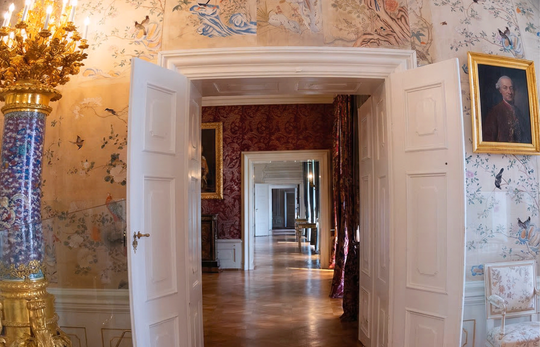
On the southern Piano Nobile, the grand sequence of rooms once followed a strict division: the prince’s private chambers lay to the east, and the princesses to the west. Each had their own suite for sleeping and receiving guests. At the heart of the floor, however, was the shared domain—the 'dining room' for family meals and the 'grand games room' for entertainment. Many of the rooms still retain their original wooden floors. Over 200 years old, they feature warm tones and a pattern that artfully combines walnut and oak. The light-coloured, freestanding tiled stoves from the Classical period also feature in several of the rooms. The rest of the furnishings, however, were often rearranged in keeping with the spirit of the times to create changing atmospheres.
Foyer of the State Rooms
The Stage for Arrivals
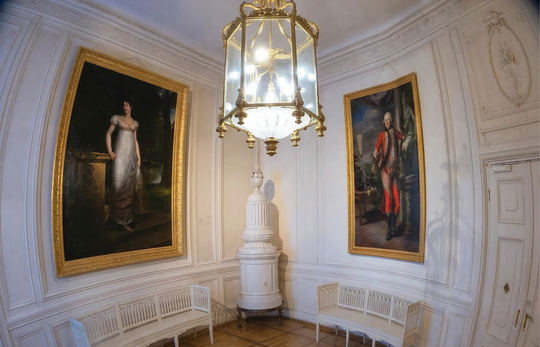
In its heyday, the foyer of the state rooms was a place to see and be seen—a whisper of silk, a meaningful glance across the crowd. Today, it remains the social heart of the house during events. But the roles have changed. Now, it is the room's occupants—larger-than-life portraits in period attire—that form a silent, stately welcoming committee for visitors.
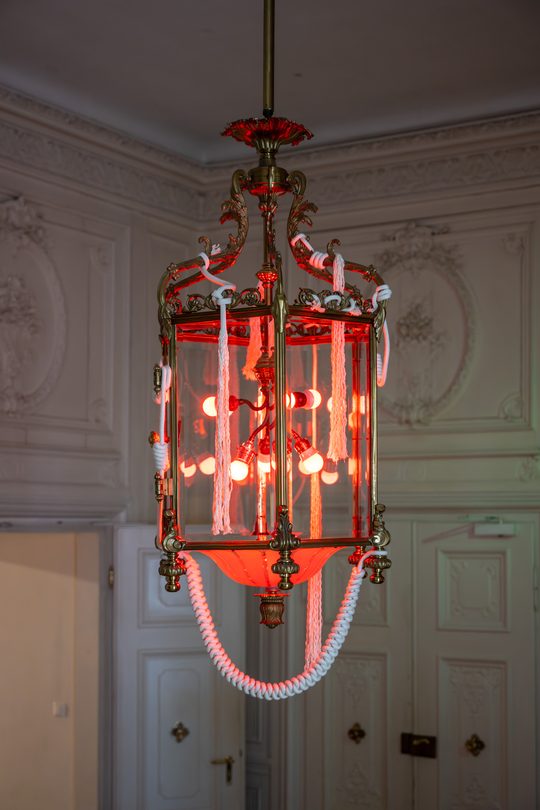
Glow of Light in the Foyer
Light, immaterial and omnipresent, only becomes perceptible when reflected by the surrounding surfaces. With their intervention on the central chandelier in the foyer, the trio of artists draws attention to the immaterial forces that constantly shape perception and experience.
Since 2014, Judit Kárpáti (b. 1989, Miskolc) and Esteban de la Torre (b. 1984, Mexico City) have worked together as the artist duo EJTECH. For their spatial installations, they frequently collaborate with sculptor Tamás Melkovics (b. 1987, Székesfehérvár); together, they treat materials as living entities, blending technology and spirituality to generate new rituals.
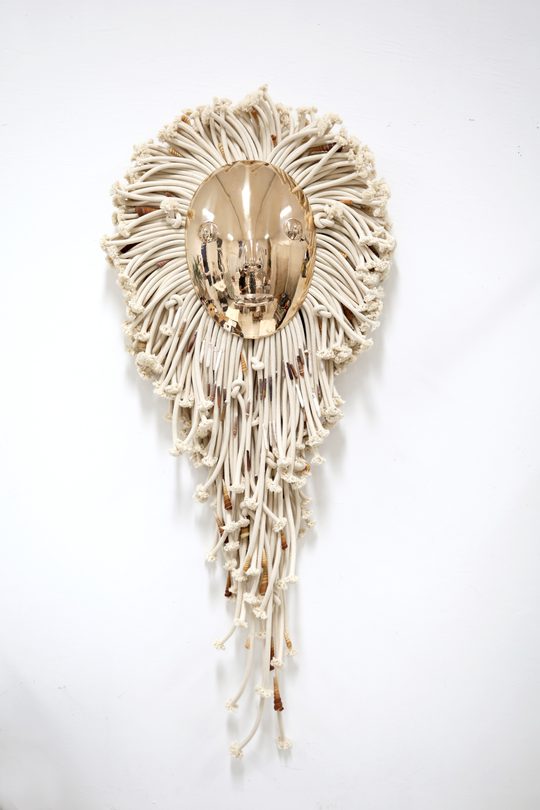
Nature Spirit
Like the character Kaonashi (Japanese), Tamás Melkovics’ mask resembles a psychological mirror capable of revealing the viewer’s fears, desires and inner truths. The face is made of polished brass, whilst the hair is crafted from cords featuring shells and other twisted objects.
Vaulted Gallery
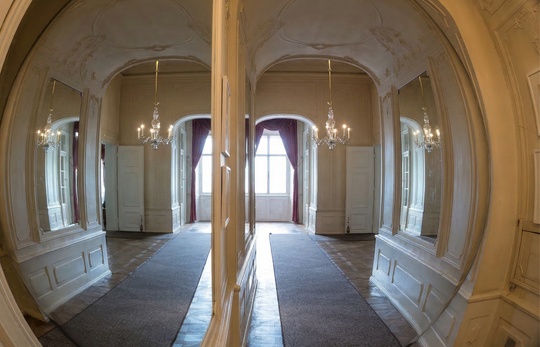
A Dialogue with the sky
From the foyer, a narrow, vaulted corridor draws you deep into the south side of the palace. At the very end of the gallery, a small dome opens above the windows, drawing the eye upwards and captivating the viewer. The masterful frescoes, which display their colours here, date back to the Baroque period. They depict not only gods and figures, but also embody ideas: victory, painting, architecture and justice. Here, the vault itself tells a story of how power and beauty once aspired to stand on equal footing with the gods.
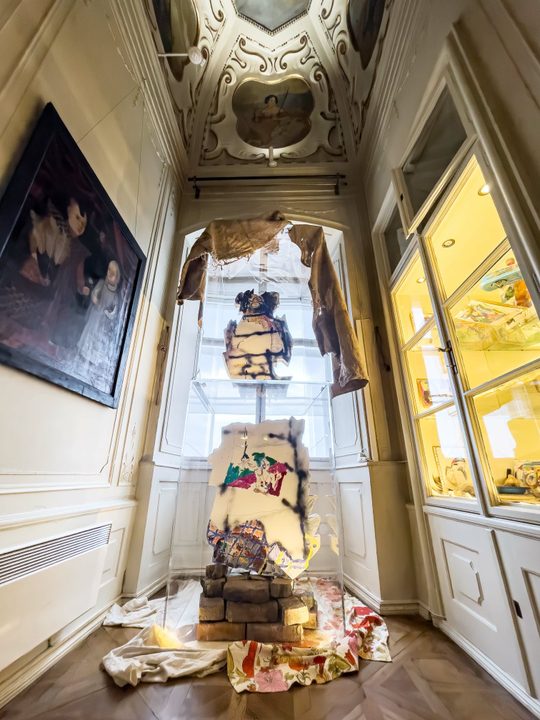
Towers and Their Shadows
The arrangement in the illuminated display cases and glass boxes resembles a Baroque cabinet of curiosities: the entire complexity of the world appears to be condensed within them into a manageable microcosm. Some of the drawn shadow towers are reminiscent of the keep at Forchtenstein Castle, others of the Tower of Babel. The painted canvas objects, in turn, pile sketches of memories into a mountain range.
The works of Gábor Pap (b. 1991, Szentes) revolve around the erosion of sensitivity and reason, the destructive nature of humanity and – much like director Béla Tarr’s concept of ‘cosmic filth’ – the awareness of an ‘original sin’. In the exhibition, Pap has staged an idiosyncratic ‘cabinet of curiosities’ at the end of the vaulted gallery.
The Chinese Fireplace Room
A Journey to a Distant Garden
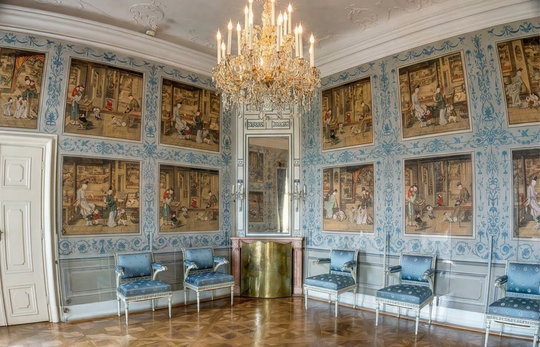
In the 18th century, the European nobility often dreamt of exotic worlds. Distant China, in particular, sparked a deep longing. To satisfy this, entire rooms were frequently decorated with appropriate wallpapers and imported porcelain.
At Esterházy Palace, no fewer than five rooms have been preserved in which the walls are clad in original fabric and paper wallpapers from China. The prince’s former fireplace room, too, is adorned with such an exotic design. It completely envelops the small room with scenes from a Chinese garden, which, with its open terraces, bizarre rocks and gnarled trees, its bonsai and potted lotus plants, was so very different from the European gardens of that era. In the foreground, three different scenes featuring children are repeated.
In situ, the precious papers are framed by carved or painted ornaments that imitate the simplicity of Chinese blue-and-white porcelain. The seating in the room has also been coordinated with its serene colour scheme.
Pro-Habiting
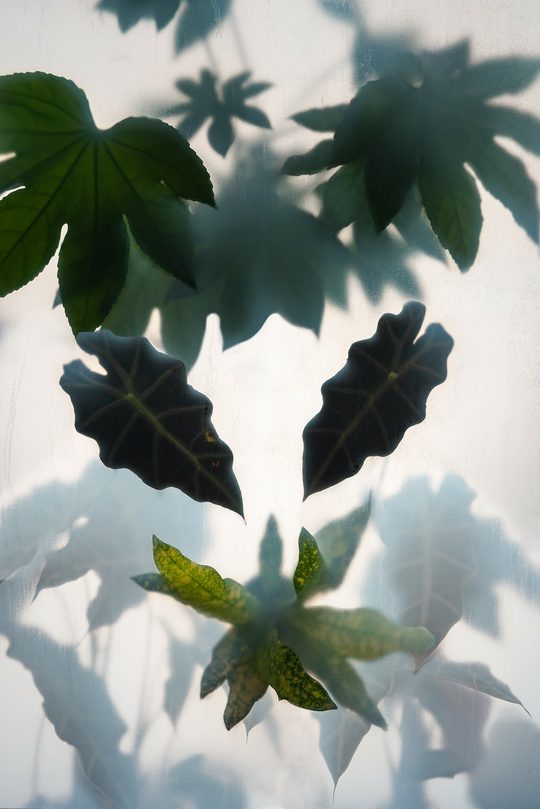
The photographic film in the lightbox depicts leaves emerging from a diffuse mist, forming a face. The green leaves belong to a plant species that were imported from Asia to Europe and have since developed into proactive and often controversial players in the ecosystem. On site in the ‘Chinese Fireplace Room’, the plant-like newcomer stares defiantly at the castle’s visitors. For this foreign face is also a revenant of the Chinese garden scenes depicted on the surrounding wallpaper.
Dorottya Vékony (b. 1985, Debrecen) has been exploring issues of fertility and reproduction – in both humans and plants – for many years. Her spatial installations depict a future in which biological and social norms become blurred and human intervention radically alters nature. For the current exhibition, the artist has created a backlit photographic work in which collaged plants imported from Asia appear as provocative newcomers, gazing defiantly at visitors in the ‘Small Chinese Salon’ with a strangely familiar look.
The Hall of Mirrors
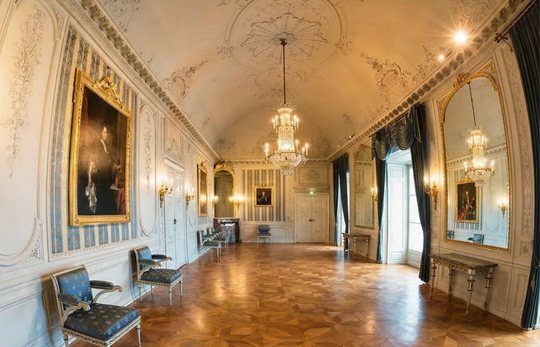
A Cheerful Central Space
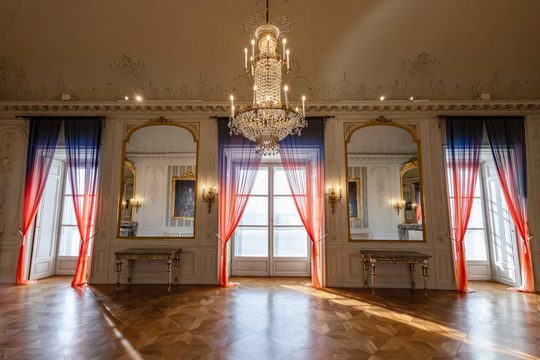
In the heart of the palace, society gathered for cheerful games, lively conversations and glamorous evenings. In the 18th century, a billiard table gave the room its former name: ‘The Great Games Room’. When a neoclassical balcony was added to the Baroque palace façade in 1897, the hall was simply called the ‘Balcony Room’. Yet on the spot, it tells a very different story: the white wooden panelling on the walls depicts various musical instruments and evokes memories of past concerts. The magnificent frames of the paintings are crowned with golden scrolls; three large windows, two opulent mirrors and elegant table ensembles lend the room a luminous grandeur. No wonder a new name soon became established: ‘the Hall of Mirrors’.
Folded Times
The windows of the Hall of Mirrors look out onto a landscape that usually appears unchanged to us yet are in fact constantly shifting. The curtains by EJTECH aim to illuminatingly frame this kind of multi-layered temporality. Whilst the draped fabric unfolds differently time and again under the influence of light, it simultaneously reflects the stories hidden within the surrounding architecture.
The Red Salon
Where the Past Whispers
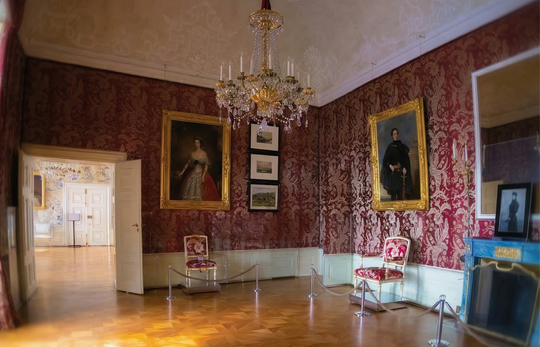
The Red Salon still holds its breath, heavy with the memory of imperial elegance. Once a private retreat for the Esterházy princesses, this chamber beside the bedchamber welcomed quiet moments of reprieve. Yellow textiles once bathed the semi-private sitting room next to the bedchamber in a bright glow. It was not until around 1850 that the colour for which it is named made its appearance. The red silk wallpaper with its silver acanthus leaves probably originates from the famous workshops of Lyon. Yet what was once magnificent now feels eerie: the sombre gazes in the historicist paintings, the photograph of Empress Sissi in mourning dress, the heaviness of the colours – they weave an aura that gets under your skin.
Perhaps it is precisely this melancholy of the past that makes the Red Salon so special. Here, between the magnificent walls, there is a whisper in the air – as if the spirits of those who once came and went here still float through the open tapestry doors.
The Grand Chinese Salon
A Room of Serene Tranquillity
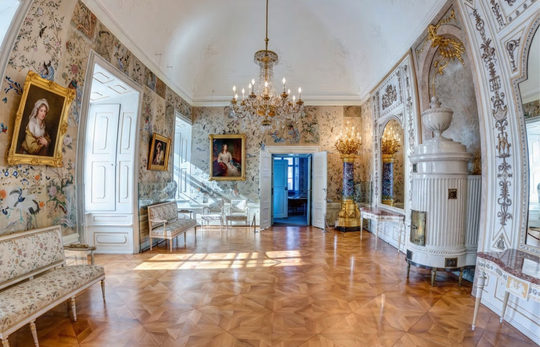
The next room, by contrast, is serene and bright: the ‘Grand Chinese Salon’. It was once the princess’s bedchamber and was entirely decorated in blue: from the wall hangings and the four-poster bed to the curtains and upholstery.
It was not until the second half of the 20th century that the mirrors framed by white Rococo panelling and the precious Chinese paper wallpapers came together here. Since then, the room has resembled an airy aviary. Countless exotic birds enliven the walls – blackbirds, herons, parrots, cranes. There are even a few kites flying on the two large candelabra columns in the corners. Their column shafts, made of colour-glazed ceramic, come from China, whilst the golden bases and capitals were crafted in Paris. Thanks to its symmetry, the room exudes a great sense of calm despite the abundance of fauna.
Presence and Echo
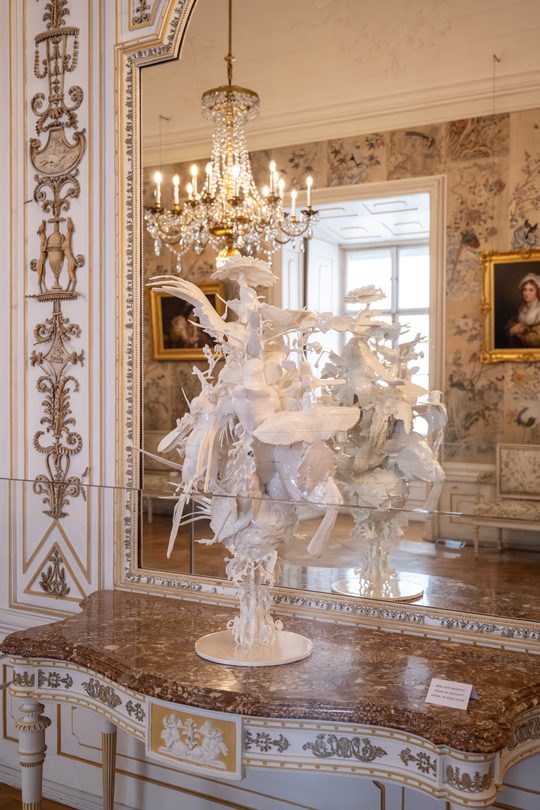
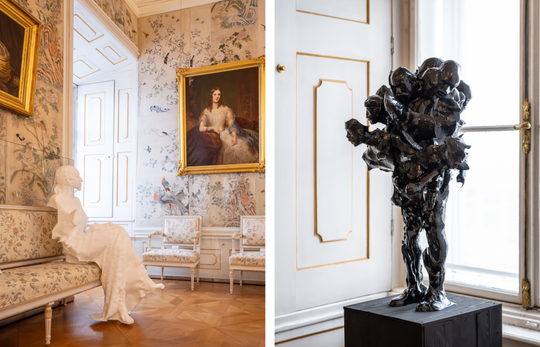
The sculptures, composed of various spatial ornaments and body positions, were created using photogrammetry. The individual parts were produced using 3D printing. Permeated by digital system errors, the spatial imprints reflect the diversity of our personalities and the layers of identity and time. On site, the sculptures also stage cross-epochal shifts in perspective.
Until now, Gábor Koós (b. 1986, Losonc) has primarily presented large-format frottages and abstract woodcuts to the public. His most recent works, however, are 3D-printed spatial sculptures made from epoxy resin, created using photogrammetry. They explore themes of memory, fragmentation and the unconscious. Koós has placed three sculptures in the former bedroom of the princesses, each composed photogrammetrically from spatial ornaments or body postures, staging a shift in perspective that spans the ages.
The Empire Room
The Former Dining Room
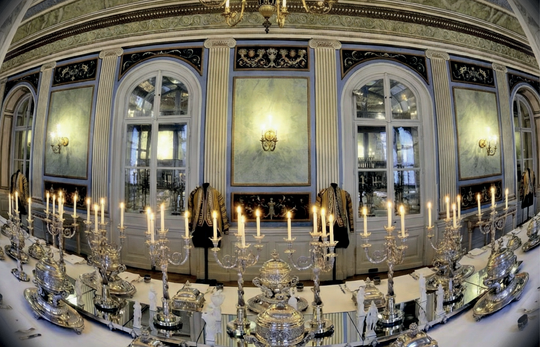
Right next door was the family dining room, known in the 17th century as the ‘dining chamber’. At that time, the room was still adorned with Baroque frescoes. During the Classical period, it was redesigned with Pompeian-style wallpaper – everything in it evoked ancient festivities and Roman power. The theme is woven into every detail—even the stove is alive with dancing maenads, piping flute players, and heavy garlands of grapes.
A laid table in the castle’s former dining room, featuring the Esterházy princes entailed silver from around 1800 – the largest surviving set of tableware from this period in the world. The festive table was reconstructed on site in 2012 for a photo shoot. Thanks to their magnificent liveries, the former servants were also present in spirit.